


History of Hardware: Nintendo 64 Expansion Paks
Welcome to a new series of blog posts I hope to write entitled the History of Hardware, where I take a look at some lesser known examples of video game consoles or accessories. These days, I find the physical devices of years past almost more interesting than the software that ran on them, and there is a rich collection of products that are fascinating in their own way, but largely lost to time. These accessories are not only interesting to examine on their own, but also give us a glimpse back in time to what problems (or perceived problems) consumers had. The successful ones would dictate the direction the industry would move itself in, while the failed products give us a vision of a future we did not experience.
To begin, I want to go back and take a look at the humble Nintendo 64. This was the console of my youth, and while I personally didn't own a unit until a few years ago, many of my friends and relatives did, and playing games at their homes was among my first introduction to gaming. The N64 is known for being an outlier in a few ways. It remained a cartridge based system while the rest of the industry embraced optical-based media (a decision Nintendo is still criticized for). It attempted to be forward looking with its embrace of 3D graphics, while also acknowledging that technology in this period was moving at a rapid pace. This fact necessitated the designers of the N64 to hedge their bets somewhat, so they included several expansion ports in an attempt to future-proof their console.
This wasn't an unusual practice at the time. Sega for example had leveraged an expansion port on the bottom of the Genesis for their Sega CD console. The N64 would include an expansion port on the bottom as well — which was eventually used for the ill-fated N64DD system, a story for another day. These ports are largely unknown to the general audience though, who would only discover them if they went looking on their console. Instead, I want to focus today on the expansion port that all Nintendo 64 owners knew about, the one they picked up and held in their hands.
The N64 controller is famous (or infamous) for its design. With 3D gaming being a bit of a gamble, Nintendo decided to design a controller that could serve both to play those new fangled 3D games, or if those proved unpopular with the public, could also function as a more traditional 2D pad. The controller has three prongs, with the right hand largely holding the right-most one, so that the thumb controls the A, B, and C-buttons and the index finger the R button. The left hand can then hold one of the other two prongs, with the vast majority of games electing to use the central one, so that the left thumb controls the joystick and the index finger the Z button. Had players rejected the system's terrible joystick, you could see how the left prong could've served as a traditional control scheme, with its D-pad and L button. In actuality though, the 3D joystick was a huge hit, leaving the left-hand side of the controller woefully underutilized (although some games did offer left-handed control schemes, such as Sin & Punishment).
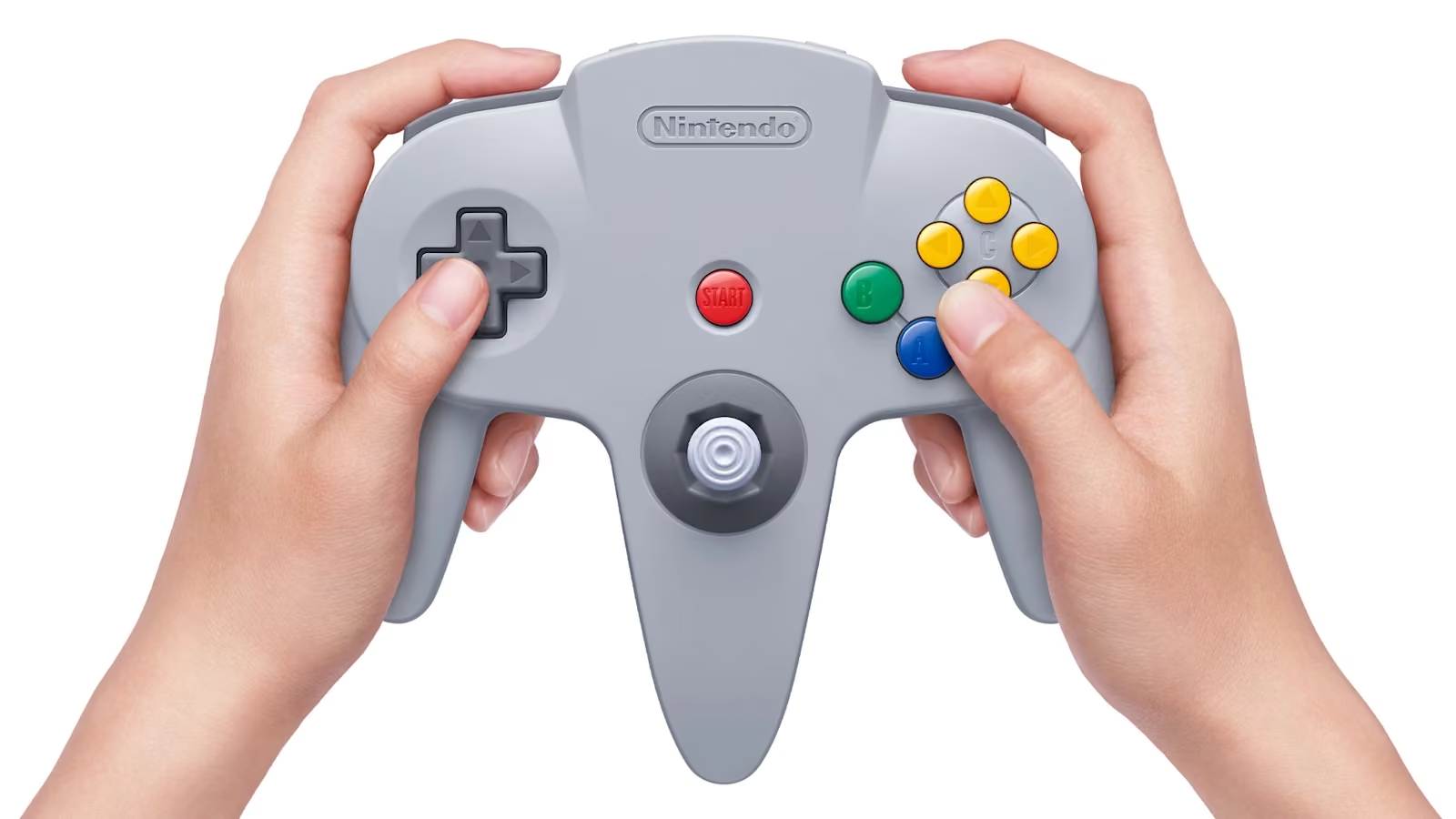
However, it is not the front of the controller that I wish to focus on today, instead what is located on the rear, just above the Z button. All N64 controllers have a gaping maw on the backside, featuring an expansion port surrounded by a moulded plastic sheath. While controllers would function just fine with nothing inserted into them at all, these ports gave Nintendo the opportunity to develop accessories that could be used on a player-by-player basis. Throughout the console's lifespan, they would release three such devices — the Controller Pak, the Rumble Pak, and the Transfer Pak.
The Controller Pak
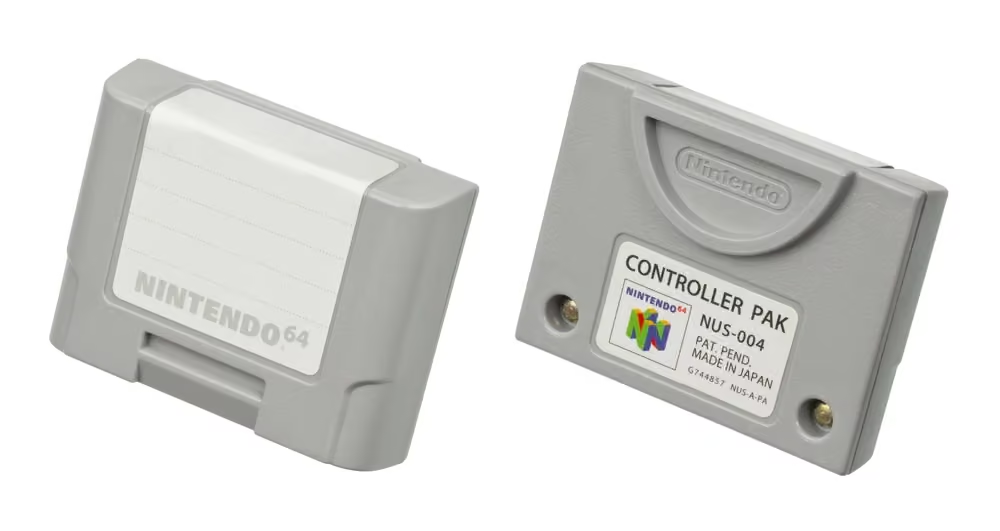
The first of these, the Controller Pak, was made available at launch, but it is arguably the least known of the three. This was the N64's version of a memory card. Unlike the PlayStation or Nintendo's own future GameCube, the N64 had no memory card slots on the main console itself, instead relying on Controller Paks that could be plugged into each controller for storage, a method that Sega would adapt for its future Dreamcast system.
Despite how ubiquitous PlayStation memory cards are, you might be surprised to learn that the N64 offered some as well, as many players saved their games just fine without them. The difference is that the PlayStation was a CD-based system, and these CDs were read-only, meaning that save data had to be stored onto a separate storage device. The one advantage of being cartridge based was that the N64 could still use battery-backed memory or even SRAM on the cartridge itself to store data. This was incredibly common on first-party Nintendo titles, which is why players everywhere were able to save their copies of Super Mario 64 or Ocarina of Time just fine, without requiring a Controller Pak.
The inclusion of on-cartridge saving is a case-by-case basis though, developers were under no obligation to include it. The Controller Pak was really designed so that developers could cut costs, moving the cost of saving from every single cartridge they made to a one-time purchase for the end user. As you can imagine though, this strategy didn't work well in practice. Unlike the PlayStation where every game required a memory card, so you could safely assume the player had one, the average N64 user was much less likely to have a Controller Pak, as most of the big name first-party titles didn't need it. Thus, many developers ended up choosing to include on-cartridge storage as well, leaving the Controller Pak largely for optional storage or transferring data between games.
The Controller Pak itself is just a fancy battery-backed storage device, requiring a standard CR2032 "watch battery" to power it. Official ones from Nintendo could store a whopping 32 KB of data, although licensed third-party ones had capacities in the megabytes. Due to the small capacity, it wasn't uncommon for some games to use most if not all of the storage space, meaning players would potentially need to own more than one, similar to memory cards on other systems. There are a few notable titles that did use it though. Mario Kart 64 is perhaps the most famous, using it to store data for the Time Trial Ghosts, as their data couldn't fit onto the cartridge storage. Dōbutsu no Mori (the Japanese-only precursor to the GameCube's Animal Crossing) used it to transfer data to other towns. Many other games would make it available as an optional storage device, alongside saving directly to the cartridge, although some games like Quest 64 only supported saving to a Controller Pak. A full list of supported games can be found here.
The Controller Pak released at launch alongside the Nintendo 64 itself and retailed for an extra $19.99, a bit of a high ask given new games were only $49.99. It's fairly easy to see why many players chose to forgo one, I myself still don't have one either. What I do have though, is Nintendo's second controller accessory, perhaps the most famous of the bunch.
The Rumble Pak
Fast forward a year to 1997. Haptic feedback in games is still largely unknown outside of select arcade machines, but Nintendo has plans to change that. Pretty much every flagship console for the last 25 years has supported rumble functionality, but it's easy to forget that this wasn't always the case. To accomplish this, Nintendo again leveraged the controller's expansion port to accept the Rumble Pak, which varies from the Controller Pak in a number of ways. Rather than focused on supporting the entire console, the Rumble can be toggled separately for each player. It's also rather larger than the Controller Pak, extending in a vague mushroom shape past the plastic housing of the expansion port. This design is not only needed to contain the rumble components themselves, but also for two AAA batteries which powers the rumble motor separately (some later third-party versions were designed to draw power from the controller directly, but as a result they yield a more wimpy result).

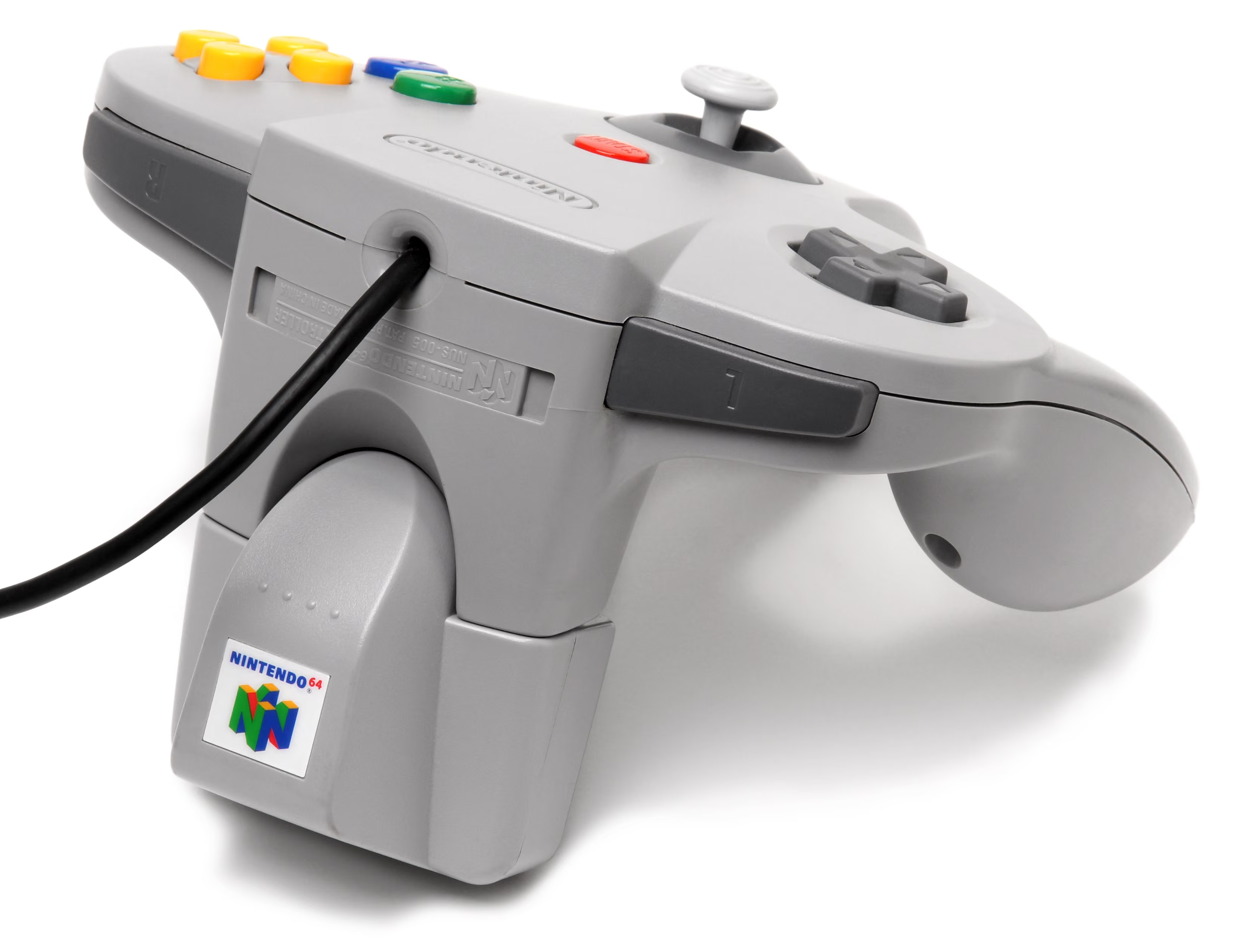
The effect is achieved by a single, off-balance electric motor inside the end of the Pak. This intentional misalignment in the motor caused a sensation like a poorly balanced washing machine, leading the entire controller to vibrate in your hands. Certain supported games had the ability to toggle this motor at will in time with the gameplay.
The Rumble Pak was bundled alongside Star Fox 64, and eventually released as a separate purchase a few months later. Like the Controller Pak before it, games had to be specifically programmed with rumble support, but the success of the accessory quickly made this a standard feature in most games. Some previously released games — most notably Super Mario 64 and Wave Race 64 — even got Japanese re-releases to support the feature, although these sadly never made their ways overseas. The full list of supported titles is quite extensive, making the Rumble Pak arguably the N64's most useful accessory. If you're curious for a more in-depth showcase, Modern Vintage Gamer on YouTube has an excellent deep-dive, showcasing the peripheral and even some homebrew application. One thing to note though, is that using the Rumble Pak meant that the Controller Pak could not be simultaneously used. While some games did allow for the Controller Pak to function in a secondary controller, most titles that supported both required the player to choose between their preferred player 1 peripheral.
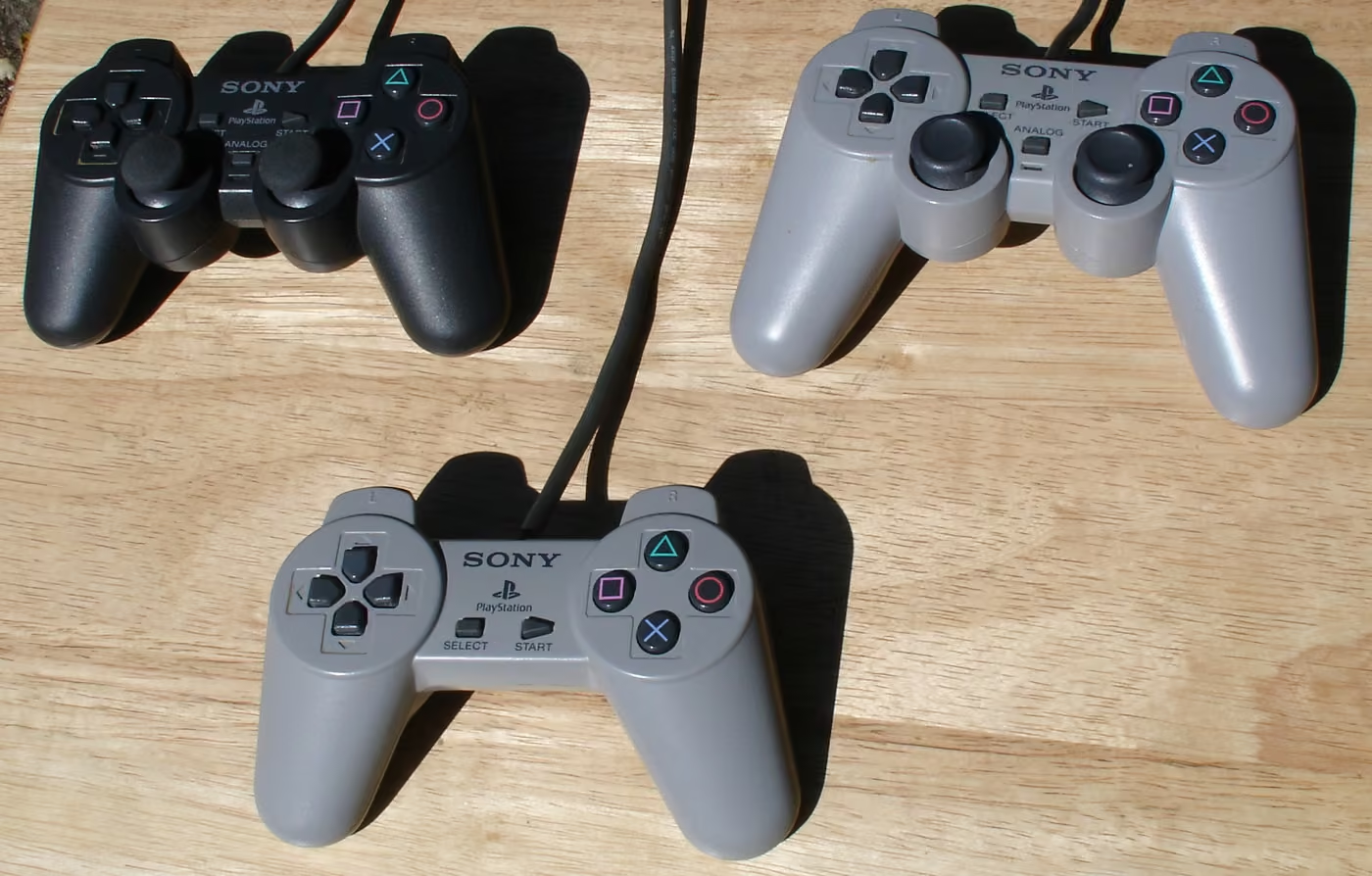
The impact of the Rumble Pak does not end within the console's own library, and Nintendo's competitors were not ignorant to the success and popularity rumble was having, going so far as to adapt it for their own needs. Sony in particular thought this was such a brilliant idea that they redesigned the standard PlayStation controller to include the feature. In late 1997 they released the DualShock controller, whose name derives from not one, but a pair of vibration motors, one in each grip. These motors are not identical, with the left one being larger than the right, allowing for varying degrees of intensity. Like the Rumble Pak, earlier PS1 titles were sometimes re-released with DualShock support, such as the (infamous) example of Resident Evil: Director's Cut DualShock Ver. with its terrible soundtrack remix.
The DualShock is often confused as the controller which also introduced analog joystick support to the PlayStation, but this is not the case. That was previously introduced with the short-lived Dual Analog Controller earlier in 1997, which even featured a single rumble motor, but only in the Japanese edition (for some reason). The DualShock proved such a success that it became the basis for the PlayStation 2's standard controller — appropriately called the DualShock 2 — and lent its name all the way up to the PS5, where the streak was broken with its rename to the DualSense.
It can be argued that popularizing vibration support in home console games is one of the Nintendo 64's biggest legacies. It's a rare instance of a post-release accessory proving so popular that it became a standard, if optional, feature for the library going forward. This is not the case for our final expansion item. It is perhaps the exact opposite of this, developed for a very specific game in mind.
The Transfer Pak
In 1996, Pocket Monsters Red and Green released in Japan and quickly became a Very Big Deal™. Pokemania swept the world and Nintendo found themselves quickly producing a large number of tie-in materials to enhance the franchise. A TV show, trading card game, and additional handheld spin-offs quickly came left and right. The Nintendo 64 was not left out, and although it never received a mainline Pokemon game (in fact, no home Nintendo console would until the Switch), it received a number of spin-off titles, such as Pokemon Snap and Pokemon Stadium. It is for the latter that Nintendo had an idea. A core part of Pokemon's success was due to the connectivity between games, leading to the "Gotta Catch 'em All" branding and encouraging players to purchase not one, but two copies of the games. Why limit this cross-system gameplay to just the Game Boy?
Thus, the Transfer Pak was born, an adapter to insert a Game Boy cartridge into the back of your N64 controller. Like the Rumble Pak and Star Fox 64 before it, the Transfer Pak was released bundled with Pocket Monsters Stadium in 1998, exclusively in Japan. The Transfer Pak wouldn't get a worldwide version until the release of its sequel — confusingly called Pokemon Stadium — in 2000. Players who owned both a Stadium game as well as a Game Boy Pokemon title could transfer their Pokemon between consoles, using the N64 both as a storage space as well as battle with them in 3D on the big screen. Pokemon Yellow took this a step further, allowing Pikachu to learn the move 'surf' only via connectivity with Stadium, which would unlock a special mini-game when transferred back to Yellow. The third game — again confusingly called just Pokemon Stadium 2 in the West — expanded support for the Game Boy Color games Pokemon Gold, Silver, and Crystal.

By the time the Transfer Pak released worldwide in 2000, the N64 was on its last legs, meaning that Pokemon Stadium remained the main focus for the accessory. However, that isn't to say that no other games or even other developers utilized its functionality, with around 20 games in total supporting it. Most of these were for Japanese-exclusive games, but a few worldwide titles did see cross-platform support. The typical pattern is that games released for both the Game Boy and N64 from the same series would receive slight extra features if paired together. Developers Camelot and Rare would both enhance their games in this way, with titles like Mario Tennis, Mario Golf, and Perfect Dark all having cross-platform features if you had both the main and handheld ports. The two Mario sports titles would allow the N64 version to unlock the characters from the Game Boy Color game, and vice versa, while Perfect Dark would easily unlock cheat modes.
One of the most unusual uses of the Transfer Pak is in combination with another Nintendo peripheral — and prime future History of Hardware candidate — the Game Boy Camera. By pairing your Game Boy Camera with a copy of Mario Artist for the N64DD (again, a topic for another day), you could take monochrome photos of the real world and import them into the game's editor mode. A neat enough feature, although requiring a N64DD, a Transfer Pak, and a Game Boy Camera made this functionality particularly obscure. Somewhat infamously, Perfect Dark was originally promoted during development as supporting the Game Boy Camera as well. You would be able to take facial photographs with the camera, then superimpose those photographs onto the faces of your multiplayer character. This functionality was cut mid-development following the Columbine massacre in 1999.

Perhaps most surprising is what the Transfer Pak couldn't do. Unlike the Super Game Boy for the SNES before it and the future Game Boy Player for the GameCube, the Transfer Pak did not allow players to play their Game Boy games directly on their TVs. The one exception to this is Pokemon Stadium, which allowed players to only play an emulated version of Pokemon Red, Blue, and Yellow. Notice how I said "emulated", as from what I can tell, the lack of general Game Boy support was a hardware limitation. The Super Game Boy and Game Boy Player were essentially physical Game Boy Colors and Advances respectively, just in a new form factor using your console and TV as a display. The Transfer Pak did not have the full Game Boy processor, it was simply a device to allow the N64 to read from the cartridge's storage.
Pokemon Stadium got around this by including a Game Boy emulator, which would then be unlocked using the Game Boy Pokemon games as a sort of key, just reading from the cartridge ROM and RAM. I imagine this emulator was trimmed down to support only what Pokemon needed, and they had no interest in expanding compatibility to the entire library. I think this is a bit of a missed opportunity, as agreed upon by Nintendo Life in their retrospective. Granted, the GameCube received a fully capable Game Boy Advance player, so perhaps Nintendo agreed with this assessment. Today, romhacks exist to allow Pokemon Stadium to play a larger selection of games, if you are so inclined.
Conclusion
The three N64 expansion paks are right up my alley in terms of combining lesser known optional features, connectivity with other games and consoles, and a general sense of "oh that's what that port was for". There's quite a few of these sorts of items floating around from years long past, and I hope reading about them is interesting. I have a few topics already in mind for the next History of Hardware so please stay tuned and look forward to those.